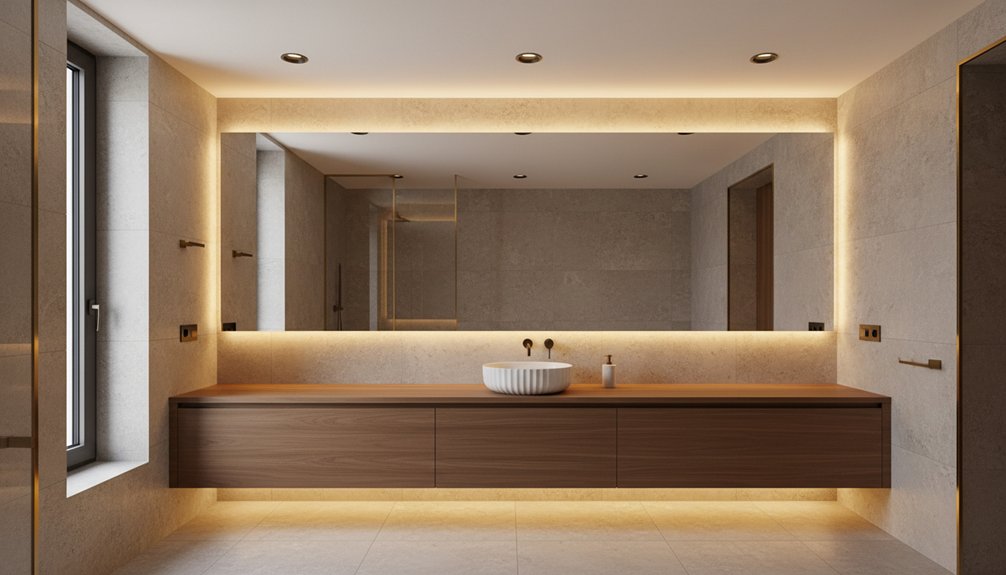
If you’re updating your bathroom this year, you’ll likely notice that modern lighting and mirrors are evolving at the same time. Start by planning their layout together so the mirror, vanity, and fixtures provide balanced illumination without crowding the space. Consider layered LED lighting, moisture-resistant finishes, dimmers, and a mirror sized to your vanity. With the right placement and electrical planning, you can create a cleaner, more functional design—and avoid a few common installation mistakes.
Key Takeaways
- Plan mirror size and placement around the vanity, basin, faucets, backsplash, wall proportions, and available electrical points.
- Layer ambient, task, and accent lighting using ceiling fixtures, sconces, pendants, or backlit mirrors for balanced illumination.
- Choose dimmable, high-CRI LEDs in a suitable color temperature, such as 3,000K warm white or 4,000K neutral white.
- Coordinate mirror shapes, frames, lighting fixtures, hardware, and finishes to create a cohesive modern bathroom design.
- Follow electrical codes, use secure wall anchors, and hire a licensed electrician for hardwired fixtures or uncertain installations.
Plan Your Mirror and Lighting Layout
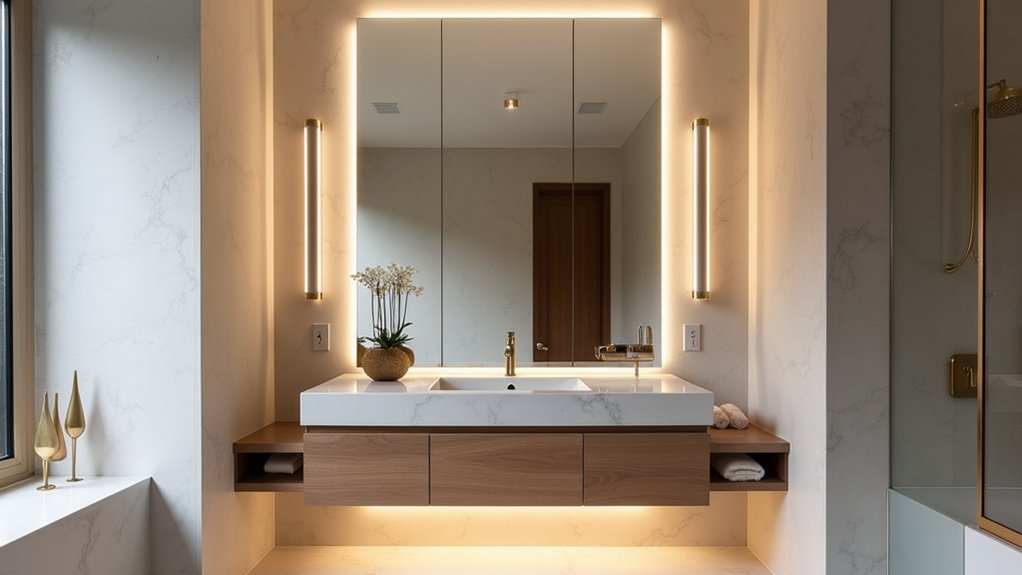
Before choosing fixtures, map the mirror, vanity, and lighting together so each element supports the others.
Measure your wall, vanity width, ceiling height, and available electrical points before finalizing mirror placement.
Center the mirror over the basin, or use two mirrors for a double vanity, leaving balanced margins at each side.
Keep the mirror’s bottom edge practical for daily grooming while maintaining clearance from the faucet and backsplash.
Plan lighting placement around the mirror’s proportions, not merely the room’s existing wiring.
Mark fixture locations on the wall with painter’s tape to check sightlines, door swings, and cabinet clearances.
Choose slim, contemporary profiles that complement your mirror frame and hardware.
Confirm mounting heights and junction-box positions with your electrician before installation, avoiding costly adjustments later.
Layer Ambient, Task, and Accent Lighting
A layered lighting plan combines ambient illumination for overall visibility, task lighting at the mirror for grooming, and accent lighting to highlight architectural details or décor.
Start with a dimmable ceiling fixture or recessed downlights, choosing a warm-white temperature that feels welcoming without distorting colors.
Add sconces or a backlit mirror at face height to reduce shadows while you shave, apply makeup, or style your hair.
For personality, install a Decorative pendant near a tub or vanity, provided it meets local wet-location safety requirements.
Use an Ambient accent, such as concealed LED strips beneath a vanity or along shelving, to create a soft evening glow.
Put each layer on separate controls so you can adjust brightness, save energy, and shift the atmosphere from morning routines to relaxing nighttime soaks.
Choose the Right Bathroom Mirror Size
Choose a mirror that matches or slightly exceeds your vanity’s width for a balanced, polished look.
You’ll also want to contemplate the wall’s proportions so the mirror complements the room without overwhelming it.
Trend-forward shapes can add character, but scale should always guide your choice.
Match Vanity Width
Match the mirror width to your vanity for a balanced, intentional look: select a mirror that’s slightly narrower than the countertop, typically by 2–4 inches on each side, so it aligns neatly without overwhelming the fixture.
This proportion keeps your vanity aesthetics polished and gives the sink area a deliberate, finished appearance.
For a double vanity, choose one wide mirror or two individual mirrors sized to each basin. Keep cabinet hardware, faucets, and mirror edges visually aligned for a cohesive installation.
Your mirror styles can reflect your design direction: a frameless rectangle feels sleek and contemporary, while a thin metal frame adds definition without bulk.
If you’re installing sconces beside the mirror, leave enough width for comfortable spacing and easy access.
Before purchasing, measure the usable vanity surface, not just the cabinet box.
Consider Wall Proportions
Beyond vanity width, consider how the mirror will relate to the entire bathroom wall. Examine the wall proportions before choosing a shape or frame.
A tall mirror can emphasize height in a room with low ceilings, while a wide design can visually balance a narrow wall. Leave enough surrounding space so the installation feels intentional rather than cramped.
For double vanities, you can use one broad mirror for a streamlined, contemporary look or separate mirrors to create definition between sinks.
Think about doors, windows, sconces, and storage that may compete for attention. Careful mirror placement keeps those elements functional and visually balanced.
If your bathroom features bold tile or patterned wallpaper, choose a simpler frame. You’ll create a polished focal point without overwhelming the room’s modern lighting scheme.
Place Vanity Lights for Even Coverage
For even, shadow-free coverage, install vanity lights on both sides of the mirror at eye level, keeping them evenly spaced from the center. This vanity placement illuminates your face from both directions, reducing shadows beneath your eyes and chin.
Position each fixture roughly 30 to 36 inches apart, adjusting for your mirror’s width and your bathroom’s scale. Maintain lighting symmetry by measuring from the mirror’s centerline before marking mounting points.
If you prefer an overhead fixture, center it above the mirror and choose a design that spreads light across the full width. Don’t rely on a single recessed downlight, which can create harsh shadows.
Use dimmable fixtures so you can shift from bright grooming light to a softer evening atmosphere.
Confirm door swings and cabinet clearances before installation.
Compare LED and Lighted Bathroom Mirrors
LED mirrors integrate energy-efficient lighting directly into the frame, while lighted mirrors may use LED strips, backlighting, or front-facing illumination to create different effects. Choose an LED model when you want a streamlined profile, consistent brightness, and lower energy use. Its integrated design can also reduce visual clutter around a compact vanity.
A lighted mirror gives you more flexibility in style and placement, especially if you prefer decorative lighting fixtures or a dramatic halo effect. Compare the mirror illumination pattern before buying: front lighting helps reduce shadows on your face, while backlighting adds ambience but may not provide enough task light alone.
Check the switch location, dimming controls, installation requirements, and replacement access. You’ll find that the best choice balances grooming performance, available wall space, and your bathroom’s design.
Choose the Best Color Temperature
Choose a bathroom mirror color temperature that supports both accurate grooming and the atmosphere you want to create. Color temperature, measured in Kelvins (K), affects how your skin, makeup, and finishes appear.
Select 3,000K for a warm, inviting glow that complements traditional or spa-inspired designs.
Choose 4,000K for balanced, neutral illumination that works well for shaving, skincare, and everyday grooming.
If you want crisp, energizing light, consider 5,000K, but avoid overly cool tones that can make the room feel stark.
For versatile control, install a dimmable mirror or layered lighting with adjustable color temperature.
You can use brighter, cooler light in the morning and shift warmer in the evening for mood enhancement.
Check the mirror’s color-rendering index (CRI); a rating of 90 or higher will show colors more accurately.
Match the temperature with your existing fixtures and design palette.
Choose Moisture-Resistant Bathroom Fixtures
Once you’ve selected the right color temperature, make sure your bathroom fixtures can withstand constant humidity and occasional splashes. Choose lighting and mirror components rated for damp or wet locations, depending on their distance from the shower or tub. Look for sealed housings, corrosion-resistant finishes, and stainless-steel or powder-coated hardware that won’t discolor over time.
Frameless mirrors with protected edges offer a clean, contemporary look while reducing moisture damage. Install fixtures with proper gaskets and Moisture barriers around electrical connections, and follow local safety codes for placement.
Strong Ventilation solutions, such as an efficient exhaust fan, help control condensation and protect both fixtures and finishes. Wipe splashes promptly, inspect seals annually, and replace any cracked components before moisture reaches wiring or backing materials.
Add Dimmers and Smart Bathroom Controls
Add dimmers and smart controls to fine-tune brightness for grooming, bathing, and nighttime visits. Install compatible dimmer switches for overhead fixtures and vanity lighting, ensuring bulbs support dimming to prevent flicker or buzzing. Choose warm, adjustable illumination for relaxing baths and brighter settings when you shave, apply makeup, or clean.
Smart controls can simplify routines through wall panels, apps, voice commands, or motion sensors. Program a gentle overnight setting so you won’t face harsh glare during late visits. Use occupancy sensors to switch lights off automatically, but position them carefully to prevent unwanted shutoffs while you’re bathing.
Select controls rated for bathroom use, and ask a licensed electrician to handle new wiring or circuits. Before installation, confirm compatibility among switches, bulbs, fixtures, and your home’s smart platform. You’ll gain flexible lighting without sacrificing safety or convenience.
Match Mirrors, Fixtures, and Finishes
Coordinate your mirror, light fixtures, and hardware finishes to create a cohesive bathroom design. Choose one dominant metal, such as brushed brass, matte black, chrome, or polished nickel, then repeat it across sconces, faucets, cabinet pulls, and towel bars. You can add contrast with a secondary finish, but keep its use intentional and limited.
Select a mirror shape that complements your room’s architecture. A rounded mirror softens angular tile, while a rectangular style reinforces clean, modern lines.
Consider decorative frame options, including slim metal, natural wood, painted finishes, or frameless glass, to support your chosen palette. Review mirror mounting styles, such as recessed, surface-mounted, or hanging designs, and match the installation’s visual weight to your vanity.
Coordinate finish undertones, and you’ll achieve a polished, current look without making the space feel overly matched.
Install Bathroom Lighting and Mirrors Safely
Install lighting according to local electrical codes, and hire a licensed electrician for hardwired fixtures or uncertain connections.
Secure your mirror with appropriate anchors and mounting hardware so it stays safely in place.
You’ll create a polished, modern bathroom without compromising safety.
Follow Electrical Safety Codes
Because bathroom fixtures operate near water, you’ll need to follow local electrical codes when planning lighting and mirrors. Check whether your area requires a licensed electrician, especially for new circuits, hardwired sconces, or illuminated mirrors.
Install ground-fault circuit interrupter (GFCI) protection wherever codes require it, and confirm proper electrical grounding before connecting any fixture. Choose damp-rated or wet-rated products according to their location, and keep switches, outlets, and connections outside restricted zones around sinks, tubs, and showers.
Calculate the combined wattage of your lights, fans, and heated mirrors to prevent a circuit overload. Don’t conceal cords, splice wires casually, or modify a fixture’s listed components.
Turn off power at the breaker, test the circuit, and consult an electrician if wiring, permits, or code requirements seem unclear. Periodically inspect for heat, buzzing, or flickering.
Secure Mirrors Properly
Once the wiring meets code, secure the mirror before connecting any lighting features. Choose mounting hardware rated for the mirror’s weight and your wall type. For drywall, locate studs whenever possible; otherwise, use heavy-duty anchors designed for the load. Proper wall anchoring prevents shifting, cracks, and dangerous falls, especially with large, backlit, or smart mirrors.
Measure carefully, mark level mounting points, and confirm clearance from faucets, doors, and electrical fixtures. Use a mounting rail, cleat, or manufacturer-approved brackets rather than relying on adhesive alone. Ask a helper to support oversized glass while you fasten each point securely.
Add safety film to the back if the manufacturer recommends it. This attention to mirror security protects your investment and creates a clean, contemporary finish. Don’t conceal access panels or wiring behind a permanently fixed mirror.
Frequently Asked Questions
How Much Does a Modern Bathroom Lighting and Mirror Upgrade Typically Cost?
You’ll typically spend $500–$2,500, watching your bathroom glow like a polished retreat. Costs vary with installation, fixtures, and Mirror materials; current Lighting trends, such as LEDs and backlighting, can raise your budget further.
Can I Upgrade Bathroom Lighting and Mirrors Without Remodeling the Entire Bathroom?
Yes, you can upgrade lighting and mirrors without remodeling your entire bathroom. Replace outdated fixtures, add layered LEDs, and install a statement mirror. Even Vintage fixtures or Traditional designs can blend beautifully with contemporary updates.
How Long Does a Typical Bathroom Mirror and Lighting Installation Take?
You’ll typically finish a bathroom mirror and lighting installation within two to four hours. Mirror materials, existing wiring, fixture complexity, and Lighting technology can stretch timing; your installer should confirm measurements and electrical requirements beforehand.
Which Bathroom Mirror Styles Work Best With Small or Unusually Shaped Bathrooms?
For small or unusually shaped bathrooms, choose frameless, round, arched, or custom-cut mirrors to maximize visual space. Use decorative frame options sparingly, and follow mirror placement tips to improve light, balance, and accessibility.
How Do I Clean and Maintain Modern Bathroom Mirrors and Lighting Fixtures?
Use gentle Cleaning techniques: spray cleaner onto a microfiber cloth, not your mirror. For Maintenance tips, dust fixtures, avoid abrasive products, dry surfaces promptly, and replace bulbs safely when they dim.
About the Author